

Want to sit in on conversations with extraordinarily great teachers? Click the My Vital Lesson photo above to visit our YouTube channel.
Featured Teacher
Jackie Acuña, Escuela de Baloncesto (School of Basketball), San Isidro de El General, Costa Rica
Classroom Magic #8: What Freddy from School of Rock Teaches Us About Student Motivation
Before we can find our reason for being, we must first find a reason for learning!
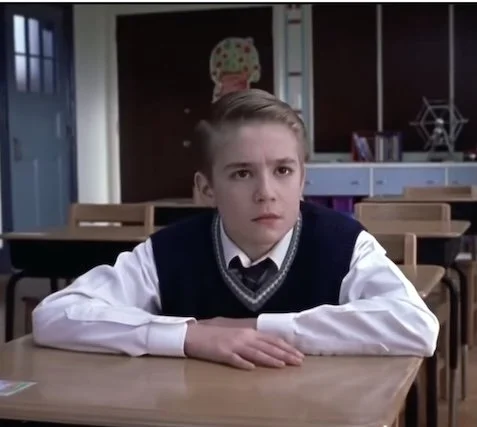
Freddy Jones in School of Rock
School of Rock is a comedy. Jack Black is hilarious as an elementary school teacher. But hidden in the fun are fabulous lessons for teachers.
One of my favorites is a scene that includes this shot of a focused Freddy Jones.
Freddy was that difficult kid with an attitude. Early in the movie, when Black asks him what he likes to do, he says, "I don't know. Burn things?"
But when he's introduced to rock 'n' roll drumming, Freddy changes. He's found something he wants to study.
Before we can find our raison d'être (reason for being), we must first find a raison d'apprendre (reason for learning). Once kids have that, once they're motivated to learn, they can learn practically anything.
But it has to start with something. For Freddy, it was percussion. For the other characters in this intense learning montage, it's something else—dance, guitar, set design, costume design, keyboard, and business.
With your students, what is it? Ask them. If you have to, probe them.
Have them identify something they want to learn. Then, as Jack Black did in the movie, help them find a reason to learn it.
Take a close look at the photo of Freddy. Note the intense curiosity. That's the look we all want to see on our students' faces.
Unfortunately, we don't see it as often as we'd like.
So, after 2003 (when School of Rock came out), I kept a blown-up photo of Freddy hanging on the back wall of my classroom. When my students weren't into my lesson, I'd glance at Freddy.
He gave me hope.
Tragic note: Kevin Clark, who played Freddy, died in 2021. He was hit by a car while riding his bike in Chicago, where he was teaching drums at a real-life School of Rock. He was only 32.
He'd been drumming since age three and, despite having no acting experience, was cast in School of Rock at 12. It was his only acting job.
Classroom Magic #7: Read this book!
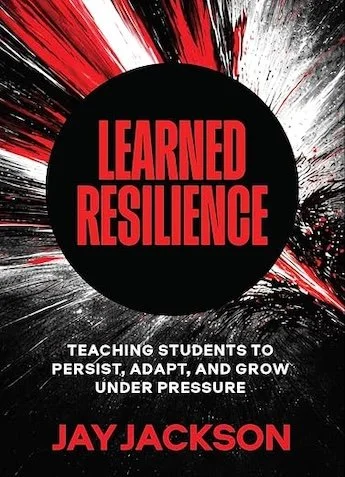
“Like life itself, school is a series of challenges. Every lesson, project, or concept is a challenge that teachers present to students. As educators, it’s our job to design these challenges so students can learn and grow. The problem is that not all students understand how to take on challenges or even why they should accept them. I began to wonder whether educators could help reduce anxiety and depression by being more intentional about the challenges we assign, the level of difficulty we choose, and how we guide students in responding to them.” —Jay Jackson, p. 115
Jay’s book should be required reading for every teacher, parent, and coach mentoring kids as young as preschoolers. It’s already affecting how I “play” with my 19-month-old grandson.
On the flip side, it has me reassessing the way I look at my own challenges, even during this later stage of life. It pretty much applies to all of us. It’s so inspiring!
Jay’s a master storyteller who has overcome two huge challenges in his life. Not only will you learn how to make all your lessons more meaningful, you won’t want to put Learned Resilience down.
I judge a book based on how many resonant passages I highlight. While reading Learned Resilience, I found myself marking something on almost every page.
It’s that good.
Classroom Magic #6: Watch Together!
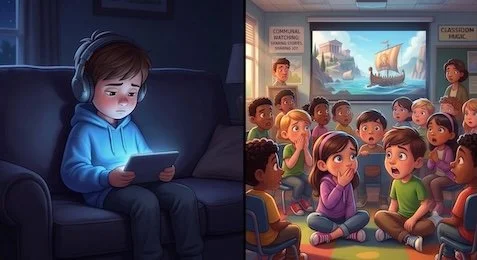
In an era of AI and individual screens, why should students physically come to school?
This happened:
First, understand that my work at National University is to watch student teachers teach, then break down what went well and what they need to fix.
One of my aspiring teacher’s lesson plan looked great.
Students will watch four TED Talks with a common theme—“What it takes to live fulfilling life.”
Students will complete a worksheet based on the videos.
Students will discuss their worksheet answers with their group mates.
Technically, they did all these, but the way they did them bugged me so much!
They watched videos individually on personal screens with headphones.
The completed the worksheets individually at their tables.
They passed around their worksheets and took turns copying each other’s answers.
Knock it out. Turn it in. Get a (hopefully) good grade.
Ugh.
Why come to school?
In today’s world where AI can teach almost anything—and do a pretty good job of it—why not just stay at home and learn there?
More and more students are doing just that. Since the pandemic the number of students not attending traditional brick-and-mortar schools more than doubled.
I get it. No commute. Individualized instruction. Personalized learning…
It’s a lot like the difference between watching a movie at home versus watching it in the theater.
When we’re able to watch The Odyssey at home, there are benefits.
If we miss something, we can skip back. If we have to go to the bathroom, we can press pause. We can adjust the volume. We can add captions. We can rewatch favorite scenes over and over.
What we can’t do is share the communal experience of watching something together.
At a crowded theater, we get to experience other’s reactions. We get to see, hear, and feel their
laughter
fear
anger
compassion
anticipation
suspense
frustration
empathy
A shared communal experience is something students can’t get at home or in most nontraditional schools. Traditional schools place kids in a classroom where their peers aren’t necessarily like them or think like them.
It can be messy, uncomfortable, and challenging. But the reward—learning how others think and react—is huge.
When we allow students to watch and work in isolation—things they might as well be doing at home—we rob them of perhaps the biggest benefit that comes from getting out of bed, leaving the house, and entering your classroom.
So watch together.
Classroom Magic #5: Have a Classroom Playlist
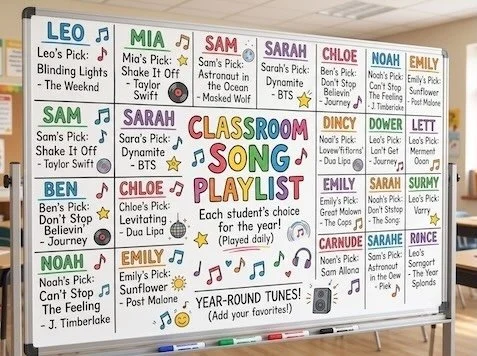
At the beginning of the year, ask each student to submit a song “for our classroom playlist.” (You submit one, too!)
Since there may be duplicates—which isn’t necessarily a bad thing—you might want to ask them to submit two or three. Later in the year, when the list gets overplayed, have them submit new songs.
Create the playlist. Then play it when kids enter the classroom, are working independently (or in groups)—you’ll sense when the time is right. I’ve even played music during testing as a way to get students to relax.
Warning: Kids, especially teenagers, can be really weird about music. Translation: They can be mean and insulting. For example: “This song sucks,” “I hate this song,” or “Who chose this? This group is so lame.”
So you’ll need to teach them how to, if not embrace, at least respect each other’s tastes.
Don’t yuck my yum! Meaning, if I like something that’s not hurting you, please don’t make me feel bad about it.
For example, if I like chocolate chip ice cream, and you don’t, you don’t have to lie and say you do. Just don’t say anything.
Or ask me why I like it. If I’m a Swiftie and you’re not, you can ask me why I like Taylor. But please don’t rip her. It makes me not want to be around you.
Once that lesson is learned, the classroom playlist can be wonderful for the classroom vibe, a unifier, a source of joy, and a reason for kids to want to come to your class.
Classroom Magic #4: When They Don’t Care, It Only Takes One
Ever feel like, no matter how great your content, your students couldn’t care less about it?
I’ve had that feeling far too often. I’d be super excited to teach something, and then look out at a sea of bored, disinterested faces.
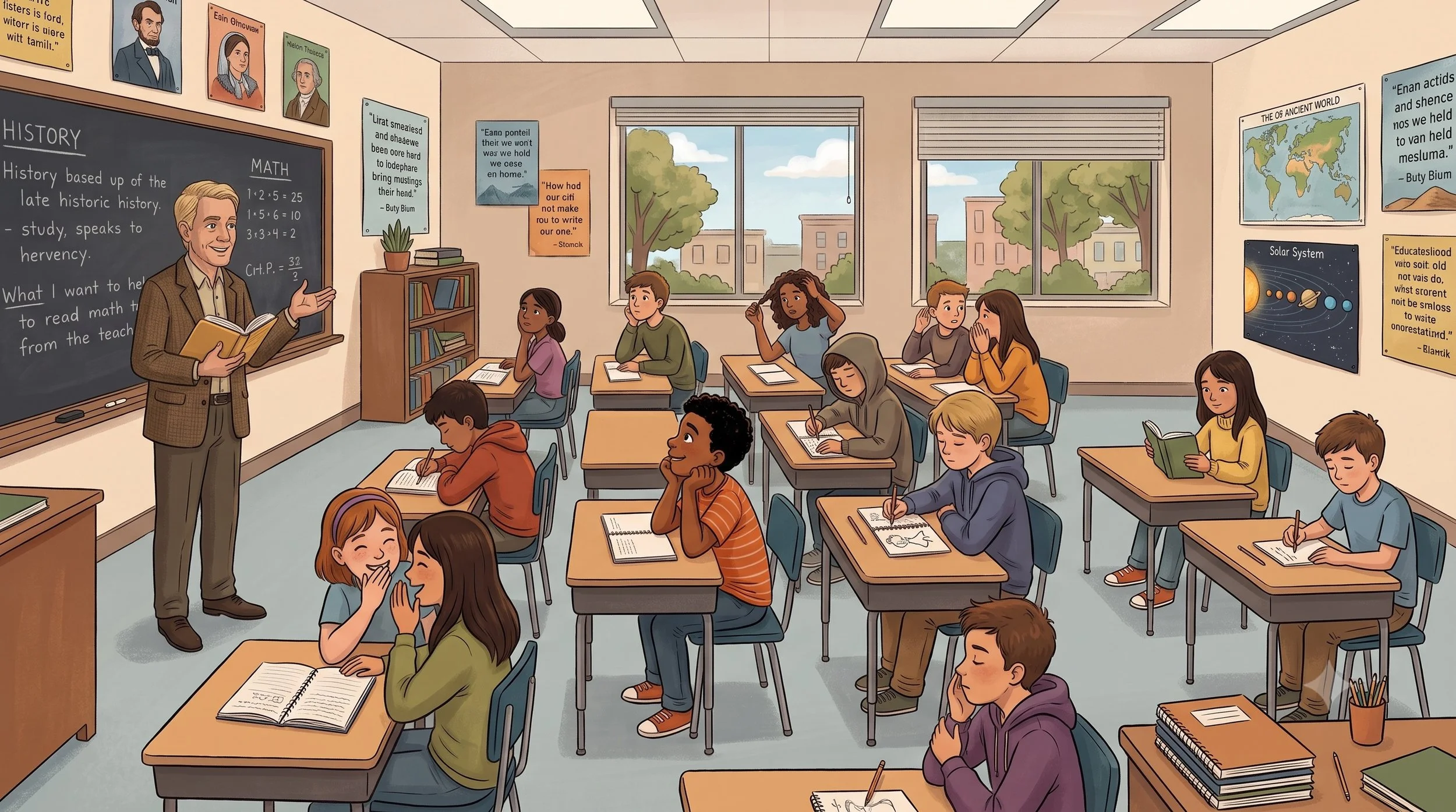
Ever feel like, no matter how great your content, your students couldn’t care less about it?
I’ve had that feeling far too often. I’d be super excited to teach something, and then look out at a sea of bored, disinterested faces.
It would make me want to cry.
But I’d teach on, straining to maintain my enthusiasm, energy, and sanity. (Teachers are some of the world’s greatest, yet unsung actors.)
Then, when all seemed lost, I’d notice that one kid who was into it, and I’d have hope.
I’d fall in love with those kids, and be so grateful they showed up. That they were in my class.
Those students—like the lady here in the red shirt, sipping her coffee, caring, and engaged—give me the strength to keep teaching. To keep going!
Even if most people walk by, ignoring David (the Busker above), I only need to reach one. One is enough.
Classroom Magic #3: Best Use of AI
The one thing a teacher can never be is boring.
This has always been the case. But never so much as now.
When kids have access to an overwhelming array of entertaining content, even the best, most dynamic, most charismatic teachers will find it difficult to compete with Instagram and YouTube.
The one thing a teacher can never be is boring.
This has always been the case. But never so much as now.
When kids have access to an overwhelming array of entertaining content, even the best, most dynamic, most charismatic teachers will find it difficult to compete with Instagram and YouTube.
But not impossible.
In 1999, a Qwest Communications commercial was filmed at Roy’s Motel and Cafe in the desolate desert town of Amboy, California. Amboy sits along Route 66, and in the commercial, a traveler stops at Roy’s.
Not expecting much, he asks, “Got entertainment?”
“All rooms have every movie ever made in any language, anytime, day or night.”
Wow.
I remember watching that and thinking, I want to go there!
I didn’t care how barren the landscape was. Being able to spend a few days watching any movies I wanted seemed really cool.
The guy asks, “How is that possible?” and the truth is, it wasn’t. Not then.
Qwest (which has since been absorbed into Lumen Technologies) was only imagining the future.
They were prescient. That future is here! Not only can we watch any movie ever made, we can listen to any song ever recorded. We can view art at every museum in the world. We can access every book ever published. Add to that all the games and new content streamed to kids’ devices 24/7. Beyond that, kids can instantly communicate with anyone, anywhere.
How can a classroom teacher compete with that?
By making the curriculum interesting, meaningful, relevant, and fun. To do that, we have to get to know our students while simultaneously understanding that even the brightest ones don’t always know what will be interesting, meaningful, relevant, and fun for them.
If you put me into that mythical hotel room, I would probably choose movies I knew about. Movies I’d already seen or heard about.
But what about all the movies I’ve never seen or heard about that might be interesting, meaningful, relevant, and fun for me to watch? The smart thing for me to do (although it fights our human default of settling for the familiar) would be to listen to a movie expert who has taken the time to learn about me.
Since teachers don’t typically get to choose their curriculum, the best ones are constantly asking themselves, How can I make this lesson interesting, meaningful, relevant, and fun for this group of students?
To do that, they must be attuned to their students—their likes, dislikes, and overall vibe.
Classroom Magic is about learning how to make school interesting, meaningful, relevant, and fun. But I write about teaching and education from a macro view. I don’t know your students and what you’re teaching them.
And when no obvious answer comes to the question, "How can I make this interesting, meaningful, relevant, and fun?"—ask AI.
If you’re teaching:
Integers
Coordinates
Subordinating Conjunctions
The Transcontinental Railroad
Area and Perimeter
The Call of the Wild
Solids, Liquids, and Gases
Just ask AI...
For example, ask AI, “How can I make The Transcontinental Railroad interesting, meaningful, relevant, and fun for my 4th graders?”
You’ll find that it will generate lots of ideas. Some might be fabulous. Some you’ll discard. Some you’ll adapt. You know your kids. AI doesn’t.
But whether you use AI or not, make it a habit to always think: How can I make this lesson interesting, meaningful, relevant, and fun for my students?
To avoid being boring, that question has to be asked.
Classroom Magic #2: The Three Questions
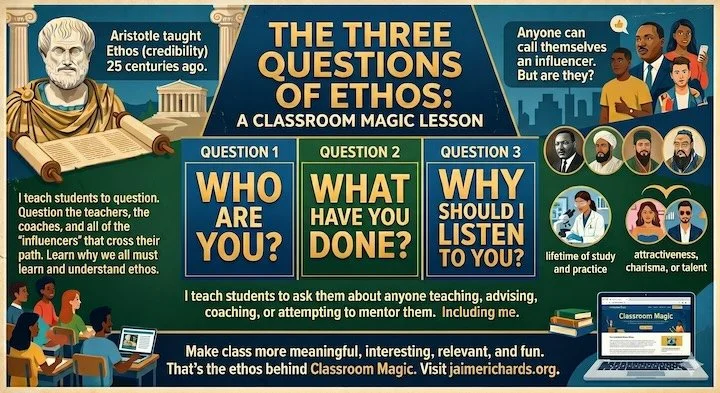
When I “created” The Three Questions lesson I had never even heard of ethos. I had no idea that Aristotle was teaching his students about the importance of credibility 25 centuries ago…
Try this:
When I “created” The Three Questions lesson I had never even heard of ethos. I had no idea that, 25 centuries ago, Aristotle was teaching his students about the importance of credibility.
Which is pretty lame since I’d been an English teacher for many years. There’ve been significant gaps in my education!
Still, “that which we call a rose by any other word would smell as sweet.” So, whether you call it Ethos, The Three Questions, or something else, it’s a critical lesson that every teacher and their students needs to know.
The three questions are
1. Who are you?
2. What have you done?
3. Why should I listen to you?
I teach students to ask them (even if only in their minds) about anyone teaching, advising, coaching, or attempting to mentor them.
Including me.
I want my students to know that I’m credible. That they can trust me. So, with as much humility as possible, sometimes subtly, I let them know that I’ve accomplished things. That I know what I’m talking about. That I’ve worked hard and paid dues.
But The Three Questions isn’t about me. It’s a cautionary tale for students.
The greatest lessons withstand the test of time, and, in our world of “influencers,” ethos is super relevant.
Anyone can call themselves an influencer. But are they? Aristotle was an influencer. So were Frederick Douglas, Martin Luther, Martin Luther King, Muhammad, Jesus Christ, Confucius, and the Buddha.
People who have spent a lifetime of study and practice who’ve accomplished something are influencers. Nobel Prize winners. Champion athletes. Research scientists. Learn the story of Barry Marshall. That guy is an influencer.
So many of today’s kids (and adults) follow influencers whose only ethos is attractiveness, charisma, or talent. We need to teach our students to challenge that.
Teach kids to research their favorite influencers. Who are they? What have they done? Why should you listen to them?
Because they’re hot? Because they can sing, dance, or play at an elite level that less than 1% of humanity has the capacity (genes) to reach?
Then, flip the question. If someone directly asked you the three questions, how would you answer?
“Who are you?”
“What have you done?”
“Why should anyone listen to you?”
How would they truthfully want to answer?
“I’m Michael Golden. I have cool name. I’m handsome, and I can run fast. So listen up!”
Sorry. Mike. You’re not an influencer. You have no real ethos.
__________
I really do have serious gaps in my education. I have series gaps in my life. Don’t ask me how to fix stuff, paint or draw anything, consistently hit a golf ball, dance, cook, or do a zillion other things.
But I’m confident that I can advise teachers on how to make class more meaningful, interesting, relevant, and fun.
That’s the ethos powering Classroom Magic.
Classroom Magic #1: Empty Your Cup!
No matter what grade or subject I teach, on our first day, my first lesson will always be “Empty Your Cup!” I want my students to know that if they’re not open to learning, I can’t teach them. I swear, Socrates, Confucius, Siddhartha (Buddha), Jesus, or Muhammad couldn’t teach a bunch of reluctant, rebellious adolescents.

Try this:
No matter what grade or subject I teach, on our first day, my first lesson will always be “Empty Your Cup!” I want my students to know that if they’re not open to learning, I can’t teach them. I swear, Socrates, Confucius, Siddhartha (Buddha), Jesus, or Muhammad couldn’t teach a bunch of reluctant, rebellious adolescents.
To drive the point home, before explaining any of this, I’ll take the whole class outside (so I don’t make a mess), and then, with no explanation, pour water into an already full cup.
After letting it overflow for a few seconds, I’d simply ask, “Everybody gets it, right?”
Of course, no one would. So we’d go back into class and I’d explain what “Empty Your Cup” is all about.