Classroom Magic #2: The Three Questions
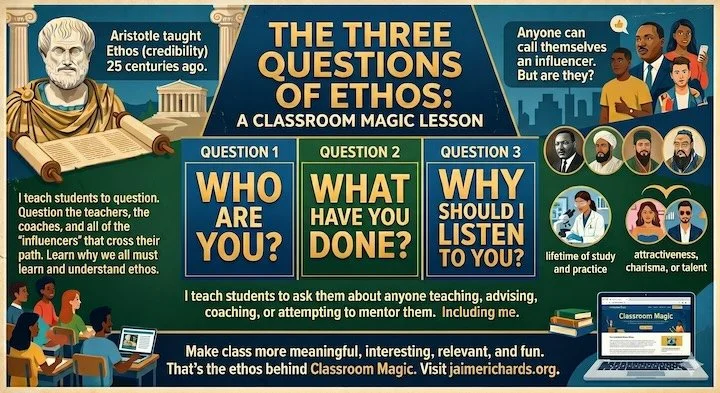
Try this:
When I “created” The Three Questions lesson I had never even heard of ethos. I had no idea that, 25 centuries ago, Aristotle was teaching his students about the importance of credibility.
Which is pretty lame since I’d been an English teacher for many years. There’ve been significant gaps in my education!
Still, “that which we call a rose by any other word would smell as sweet.” So, whether you call it Ethos, The Three Questions, or something else, it’s a critical lesson that every teacher and their students needs to know.
The three questions are
1. Who are you?
2. What have you done?
3. Why should I listen to you?
I teach students to ask them (even if only in their minds) about anyone teaching, advising, coaching, or attempting to mentor them.
Including me.
I want my students to know that I’m credible. That they can trust me. So, with as much humility as possible, sometimes subtly, I let them know that I’ve accomplished things. That I know what I’m talking about. That I’ve worked hard and paid dues.
But The Three Questions isn’t about me. It’s a cautionary tale for students.
The greatest lessons withstand the test of time, and, in our world of “influencers,” ethos is super relevant.
Anyone can call themselves an influencer. But are they? Aristotle was an influencer. So were Frederick Douglas, Martin Luther, Martin Luther King, Muhammad, Jesus Christ, Confucius, and the Buddha.
People who have spent a lifetime of study and practice who’ve accomplished something are influencers. Nobel Prize winners. Champion athletes. Research scientists. Learn the story of Barry Marshall. That guy is an influencer.
So many of today’s kids (and adults) follow influencers whose only ethos is attractiveness, charisma, or talent. We need to teach our students to challenge that.
Teach kids to research their favorite influencers. Who are they? What have they done? Why should you listen to them?
Because they’re hot? Because they can sing, dance, or play at an elite level that less than 1% of humanity has the capacity (genes) to reach?
Then, flip the question. If someone directly asked you the three questions, how would you answer?
“Who are you?”
“What have you done?”
“Why should anyone listen to you?”
How would they truthfully want to answer?
“I’m Michael Golden. I have cool name. I’m handsome, and I can run fast. So listen up!”
Sorry. Mike. You’re not an influencer. You have no real ethos.
__________
I really do have serious gaps in my education. I have series gaps in my life. Don’t ask me how to fix stuff, paint or draw anything, consistently hit a golf ball, dance, cook, or do a zillion other things.
But I’m confident that I can advise teachers on how to make class more meaningful, interesting, relevant, and fun.
That’s the ethos powering Classroom Magic.