Chapter 22: From Heroes to Role Models to Mentors—Why We Never Outgrow Our Need for Guidance
Pistol Pete
When he was 40 years old, Pete Maravich, one of my childhood role models, died while playing pickup basketball on a church court in Pasadena, California.
When I was 15 years old, I spent a summer week at “Pistol Pete’s” basketball camp in Western Pennsylvania. Pete and his father, Press, put us through drills and taught us skills that were useful and fun.
I learned a lot.
At that impressionable age, in search of mentors, Pete was perfect. Athletic. Handsome. Incomparably cool, I wanted to be him. He was my generation’s LaMelo Ball.
Pete Maravich played three years of varsity basketball at Louisiana State University. His college career scoring average was an astonishing 44.2 points per game. In the summer of 1971, the year I met him at camp, he had just finished his rookie year in the NBA.

I wasn’t thinking of Pete when I drove onto the LSU campus. I wanted to see the football stadium.
From the 1930s through the early 1990s, student living quarters were built into Tiger Stadium—“barracks” under the stands. Students lived in the stadium!
Now that’s a football school! Until Pete went there, basketball was an afterthought. Despite Shaquille O'Neal playing there a generation after Pete, it still is. So, when I saw where LSU plays its home basketball games—the Pete Maravich Assembly Center—I was surprised. Obviously Pete made an impact on a heck of a lot more people than just me. He hasn’t been forgotten.
Pete was an icon. The kind of people who have buildings named after them usually are.
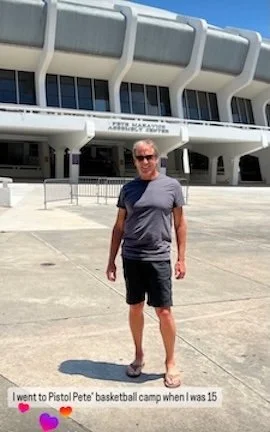
The Pete Maravich Assembly Center on the LSU campus
Place Names
No matter where I went, there were places named after people. Some famous—Washington, Columbus, Pennsylvania (after William Penn).
But most places are named after people we’ve never heard of. Delaware is famously our first state. Few know it’s named for Thomas West, 3rd Baron De La Warr, an English nobleman.
City streets and public schools are often named after people nobody knows or cares about. I taught at Hopkins Junior High in Fremont, California (named for explorer/politician John C. Fremont). Because I taught history, I felt an obligation to research who William Hopkins was.
I learned he was a landowner—he owned orchards on the property where our school would be built. But the “Why is our school called ‘Hopkins’?” lesson bored both my students and me.
I like it better when places are named after nature (Boulder), not people (Fremont)—who was at best a jerk and, at worst, an executioner. Natural resource places sound prettier and are less complicated and controversial.
Heroes>Role Models>Mentors
So why do we insist on honoring anyone who’s done anything?
Maybe putting people on pedestals is in our DNA. Maybe we’ve always needed to honor others.
When we’re small, we believe in the tooth fairy, Santa Claus, and the Easter Bunny. Superheroes—Superman, Batman, Wonder Woman…—don’t seem fantastical when we’re five. It’s reassuring to think icons walk amongst us.
By middle school, most of us get that there are no saviors. But like me when I was 15, we’re looking for role models. People whose lives we like. People we want to be like. Pete was one of those for me.
After adolescence, if we have enough self-esteem, we outgrow our role models. We realize we’ll never be them. We’ll never have their lives.
If we’re wise, we’ll search for mentors. Mentors don’t have magical powers. We probably wouldn’t exchange our lives for theirs. But we can learn from them. And we’ll never outgrow the need for them. I’m 70 and I still seek mentors.
Most mentors won’t have streets, schools, cities, or buildings named after them. They might not have done anything spectacular. They probably didn’t own thousands of acres of land, win military battles, or get elected to office (and name things after themselves). They probably haven’t donated huge sums of money and they definitely didn’t average 44.2 points per game.
They’re just good, humble people who’ve never considered themselves a guru or sage. Yet the way they live makes them both.
For many years, I’d take my students on a BART train trip to San Francisco for a walking tour. We’d start at the Ferry Building, then make our way to Ghirardelli Square, Pier 39, then back to BART. Behind the Ferry Building is this statue:
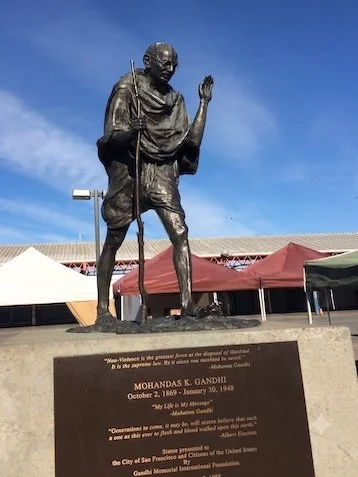
I’d ask each student to focus on and think about one five-word sentence engraved on the bronze plaque affixed to the pedestal supporting Gandhi.
“My life is my message.”
Homework: We can learn how to live (or how not to live) by observing how others live. List three people you consider mentors. Or three people you’d like to have as mentors. They may be well-known, but they may not be. You may know them personally, but you may not.