Classroom Magic #6: Watch Together!
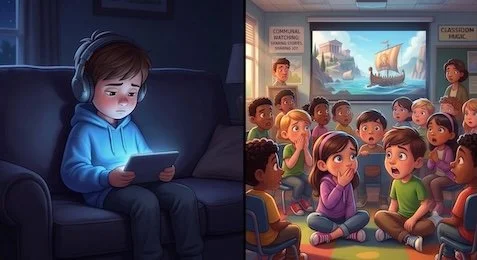
This happened:
First, understand that my work at National University is to watch student teachers teach, then break down what went well and what they need to fix.
One of my aspiring teacher’s lesson plan looked great.
Students will watch four TED Talks with a common theme—“What it takes to live fulfilling life.”
Students will complete a worksheet based on the videos.
Students will discuss their worksheet answers with their group mates.
Technically, they did all these, but the way they did them bugged me so much!
They watched videos individually on personal screens with headphones.
The completed the worksheets individually at their tables.
They passed around their worksheets and took turns copying each other’s answers.
Knock it out. Turn it in. Get a (hopefully) good grade.
Ugh.
Why come to school?
In today’s world where AI can teach almost anything—and do a pretty good job of it—why not just stay at home and learn there?
More and more students are doing just that. Since the pandemic the number of students not attending traditional brick-and-mortar schools more than doubled.
I get it. No commute. Individualized instruction. Personalized learning…
It’s a lot like the difference between watching a movie at home versus watching it in the theater.
When we’re able to watch The Odyssey at home, there are benefits.
If we miss something, we can skip back. If we have to go to the bathroom, we can press pause. We can adjust the volume. We can add captions. We can rewatch favorite scenes over and over.
What we can’t do is share the communal experience of watching something together.
At a crowded theater, we get to experience other’s reactions. We get to see, hear, and feel their
laughter
fear
anger
compassion
anticipation
suspense
frustration
empathy
A shared communal experience is something students can’t get at home or in most nontraditional schools. Traditional schools place kids in a classroom where their peers aren’t necessarily like them or think like them.
It can be messy, uncomfortable, and challenging. But the reward—learning how others think and react—is huge.
When we allow students to watch and work in isolation—things they might as well be doing at home—we rob them of perhaps the biggest benefit that comes from getting out of bed, leaving the house, and entering your classroom.
So watch together.