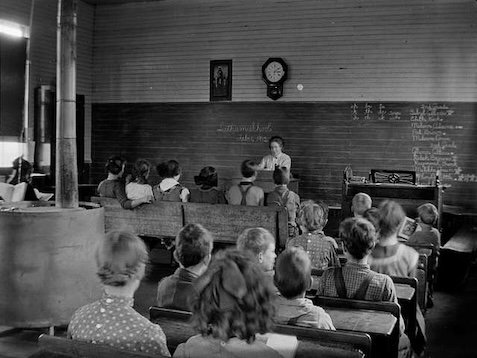
Photo: Roy C. Andrews Latham One Room Schoolhouse Western Oregon, 1912
Starting when I was a kid in elementary school, I’ve believed schools can be so much better. It’s one of the reasons I became a teacher.
So, as soon as I had my own class, I began my battle against the status quo. I’d look at the way things were typically done and then do something atypical.
For several years, I tried different kinds of “creative” desk arrangements—diagonals, pairs next to each other, pairs facing each other, tables of four, even a big circle (like King Arthur’s Round Table).
Guess which worked best?
None of those.
Sometimes the typical is typical for a reason. When you teach, your students need to face you and your “teaching station.”
Your teaching station is where you sit or stand during whole-group instruction. It’s where the board or screen is. If your students aren’t facing the teaching station, they’ll lose focus.
Duh.
I worked on this heartwarming, heart-wrenching memoir with my former student Phillip Bennett. Phil had been diagnosed with a horrific, incurable disease called Friedreich’s ataxia (FA).
When we started on the book, if we couldn’t meet in person, we’d talk on the phone. But as his FA progressed, his speech began to fail him, and his words grew harder and harder to follow.
Phil’s mom, Valerie, solved our problem.
“When you can’t meet, don’t call. Instead, Skype,” she said.
This was before FaceTime, and I had never heard of Skype. But when I tried it, I loved it. When I was able to see Phil’s face as he talked, I could understand virtually everything he said.
It changed the way I taught. From then on, I made sure that all my students’ desks faced me when I taught. I told them that even if they didn’t like my face, I wanted them looking at it when I spoke.
Now, I teach aspiring teachers at National University. When I watch videos of them teaching their classes, I focus less on them and more on their students. More often than not, unfocused, distracted students are not facing their teacher. Their desks are turned sideways, and some even have their backs to the teaching station.
There are two solutions:
No matter how your desks are arranged, before you start whole-group instruction, have your students stand up and turn their desks so they can look straight at you. (If you spend less of your day on whole-group instruction, choose this option.)
Arrange the desks the way they’ve been arranged since schools began—facing the front! (If you spend more of your day on whole-group instruction, choose this option.)
Look at this 1899 photo. Kids are facing the front. They’re doing calisthenics at their desks, but still facing the front.
Don’t be like me and try to fix something that’s not broken. Facing the front works.
It always has.
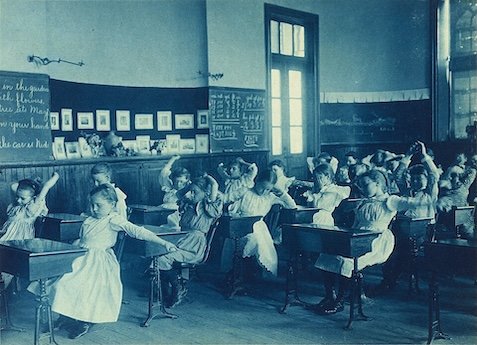
Photo: Frances Benjamin Johnston, Library of Congress, Washington, D.C. public schools